
As Women’s Month has come and gone, Ontario Cycling took time to go back through our archives and see how women’s cycling in Ontario has grown throughout the years. From 1986, where it was a significant achievement to see two or three women racing at a mountain bike event, to 2025, where we saw 78 women participate in the MTB OCup series, it is important to recognize and celebrate the growth of women’s cycling throughout all our cycling programs in Ontario.
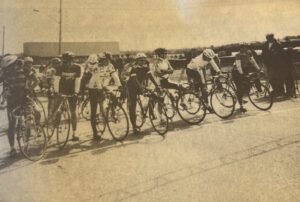
Women’s Racing divisions at events were largely considered an afterthought throughout the 1980s, if even considered at all. In some events, such as the Ontario Masters Cycling Association races, the need for organizers to distinctly invite women “women (and girls) are welcome” shows this. Women and girls were invited to hold racing licenses, but it was suggested that they race only with other women or at the cadet boys (14-15yo) level.

The Cycling Women’s Committee (CWC) reported in 1988, that “almost all races will also have events for women”. Events included the creation of a provincial girls’ BMX program and women’s classes in the mountain bike provincial race series. During the 1988 MTB season, five women competed in the expert class in its inaugural year, three new racers joined the sport class, and the novice women had up to six women at each race; this increase in racers, from only 2-3 the previous year, led to hopes of creating a pro-am category for women the following year.
“All the women who enter mountain bike races have something in common. They all [like] to have fun…and they enjoy the challenge the sport has to offer.” – Julia Biederman, 1988 Eastern Canadian Champion, on behalf of the OMBC
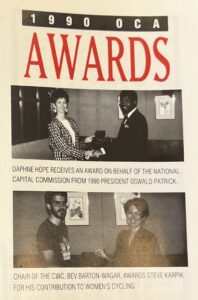
In the 1990s, the CWC continued to work on increasing education, advocacy, and representation of women in all sectors of cycling. The Committee worked to remove barriers they identified as potential hinderances for the involvement of women in all aspects of cycling, such as family and job pressures, stating these would ‘prevent women from making the necessary commitment need to develop into capable athletes, as well as the idea that people may hold outdated ideas of the activities and sports that are deemed appropriate for women. Victoria Lee, CWC Committee Chair in 1992 suggested other barriers may include “psychological intimidation by the predominance of the men in the sport, ill-fitting bikes designed for male proportions which makes cycling physically uncomfortable for women, to the lack of essential coaching necessary to develop women into strong mature athletes, the mechanical knowledge required to maintain a bike and a lack of even basic skills such as understanding gear shifting and wearing proper clothing”. Despite this, the goal of the CWC remained the hopeful achievement of equal participation between men and women in all sectors of cycling.
“The goal of the [CWC] is to put forth the view that women can and should be strong, capable and coordinated, and that such athletically-oriented self confident women are not only healthy, but also constitute an asset to our society.” (1995)
In 1992, a major achievement by women in cycling – was OC’s adoption of the harassment policy developed by the CWC, being one of the first sport regulatory bodies to introduce a policy of this level!
Women’s racing continued to progress, with women’s categories regularly being included at races, and some races having riders to allow for the division of the women’s category into age/skill level, although still far fewer category options were available than for men. Through the 1995 season, most races had at least 6 categories for men, with little to no races featuring more than two women’s categories.
Here are some examples of the large gender gap in cycling during this time:
Personal Best, a 15km ITT event designed to introduce athletes of all ages and abilities to the sport of cycling began in 1994 and was later adopted by Cycling Canada as a national event. In its first year, there were 241 racers, but only about 15% of them were women.
In 1995, mountain bike race plate numbers were assigned to top athletes so that they were kept the same throughout the season. Race numbers 1-25 were assigned to the top 25 senior elite men, while the senior elite women were given only numbers 400-404. 1500 men’s race numbers were allotted across 12 categories, with only 210 race numbers allotted for women, or about 12% of all race numbers – for every one number given to a woman, there were seven numbers given to men.
The CWC racing sub-committee reported that in 1995 there was only one licensed junior female athlete, stating there was a lack of promotion available to young women in Ontario. Although there was more participation from adult female cyclists, most Ontario races observed an average of only one female entrant per 12 male entrants.
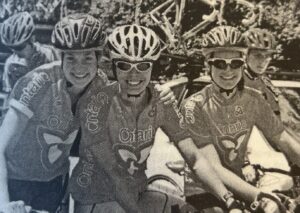
In January 1996, Women on Wheels partnered with OC as a representative body of the CWC with a goal that the partnership would be mutually beneficial; it would expand OC’s focuses beyond just racing, and address more women-specific issues, while also extending the audience of WoW from the Toronto area to all of Ontario.
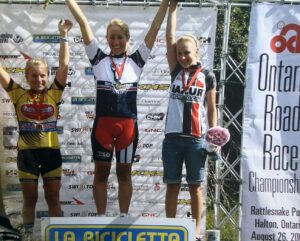
Over the next ten years, women’s racing across all disciplines began to grow, and although distances at many events remained shorter for women than for men, the number of racing categories for women in some disciplines and events, had equal categories for both women and men. In 2008, both the road OCup series and the road youth cup series featured the same category offerings between men and women. The MTB OCup series was closely equal, except for the cadet and junior categories being separate for men and combined for women. BMX was the discipline with the largest gap in this area, with races having boys’ races broken down into one year age groups while the girls just had one group to compete in.
 Women’s membership with OC has continued to grow each year since 2013. In 2013, 15% of members were female, growing to 28% in 2022. Women have continued to comprise roughly 28% of OC membership since 2022 and will hopefully continue to rise alongside overall increases in OC membership in the future.
On behalf of Ontario Cycling and all the female riders who came before us, we thank you for your continued commitment to growing the sport of women’s cycling in Ontario. Let’s continue to advocate for the growth of the sport in all communities and across all programs. Women’s cycling in Ontario is on the rise, and we all have a role to play in continuing to see it grow.